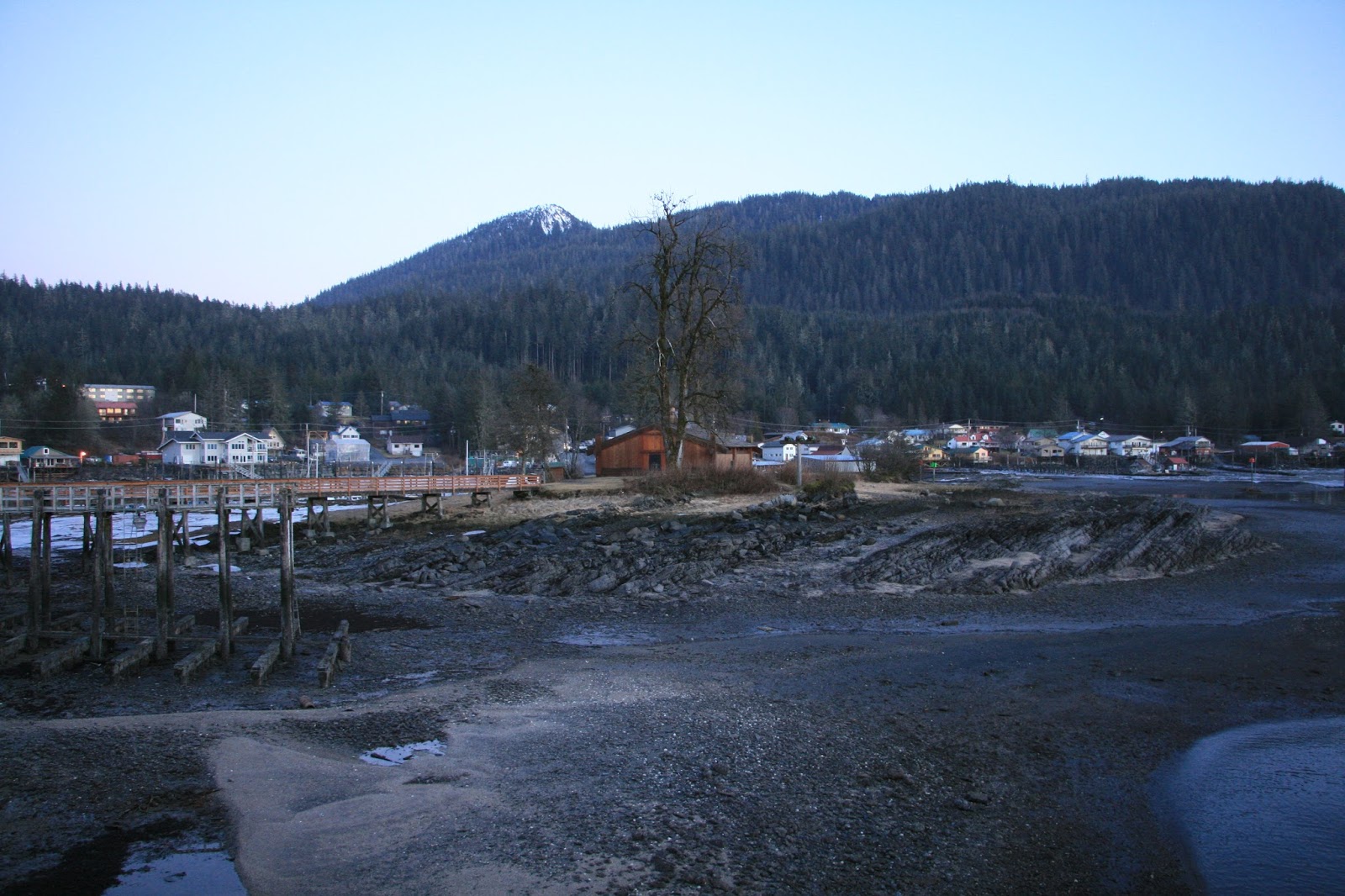
So, it's winter right? A lot of animals have been hibernating or sleeping for several months now, others have long since headed south to warmer climates, and the ones that have done neither are doing what they need to do to survive this time of cold and scarcity. The forests and muskegs and even the sea seem much quieter and empty than during the other seasons, even the deer have been scarce for the last few months. A walk in the woods can be an incredibly silent experience except for the crunch of your footsteps on the frozen ground or the sound of your own heartbeat when you stop and listen. The stark black and white of dormant plants and snow cover and the silence of winter make familiar places seem foreign and new. The silence leads me to introspection, thoughts of what is to come during the year, darker thoughts of mortality, reveries of times past, longings for warm fires and blankets, dozing in the fleeting almost warm sun, and then..............
this guy starts chattering at me and makes the present come crashing back! Keep it real little timber tiger!
It is almost the full moon and with all the silt in the air blown down the river over the last several days, it made an interesting looking moon early this morning.
Thursday, February 9, 2017
Tides and tide books
I am going to simplify the mechanism behind the phenomenon of tides to avoid making this a very lengthy post and just say that tides are caused by the gravitational pull of both the moon and the sun on the earth. The moon, being much closer to the earth than the sun, has a much greater effect on the tides than does the sun but the sun does contribute some influence. The proximity of the moon in relation to the earth is the main factor in determining the tidal range which is the difference between the high and the low tides as well as other things such as geographical features.
Typically, there are two high and two low tides per day with a roughly 6 hour period of time between each high and low tide, it is actually a little bit more than 6 hours but rounding to 6 suits our purposes just fine. Here in the Wrangell area, our biggest tidal range is about 24 feet with the smallest being about 4 feet while the biggest tidal range in the world is found on the east coast of Canada in the Bay of Fundy which is between the provinces of New Brunswick and Nova Scotia, aye. 24 feet is a lot of water but is less than half of what the Bay of Fundy sometimes gets - there is a maximum tidal range of 55 feet there! These are the extreme ranges and occur only a few times a year but even a modest change of 4 feet can cause a person some problems if they do not properly plan for it.
So, how does a person plan for the tide? With a tide book available for free from several local businesses in Wrangell! (or whichever town you are in) Since they are free and a very important reference book for anyone planning on boating, beachcombing, or really anything involving the ocean, most folks have several tide books in various places - in each boat and vehicle, float coat pockets, randomly scattered on countertops and desks, in backpacks, pretty much as many places as possible because you still sometimes can't find one when you want one!
Here are a few examples of tide books from Wrangell.
Did you find that information at the top of the page in the above photo? Very good, now on to the next steps.
Step 4: you can see 3 columns on the page, the leftmost one contains the date and day of the month, the next has a heading of High February, meaning high tides in the month of February, and the last is Low February, meaning low tides in the month of February. These columns are then divided into subcolumns of A.M. (morning), P.M. (after noon), and time and FT for feet (like the measurement not the things below your ankles). To minimize confusion as much as possible, the P.M. tides are printed in bold print.
Still there? Hello? Anyone?
Step 5: find the particular day that you want to know the tide for. I will use Wednesday, February 8th for this demonstration since that is what day I am doing this. Find it? Good.
Step 6: Now as you go across the 8 Wed row, you will see a big black dot which you should ignore for now, then you will come to 10:34 and then 17.7. Looking at the top of the column shows you that the 10:34 is the time in the morning and the 17.7 is the amount of feet. Looking further toward the top of the page shows you that you are in the High February column so you just discovered that at 10:34 a.m. on Wednesday, February 8th, there is a 17.7 foot high tide. Got it? It's not so hard right?
Keep moving to the right in that same row and you find in bold type, 11:34 15.5. You are still in the High February column so you now know that at 11:34 tonight there will be a 15.5 foot high tide. You have now mastered finding the high tide on Wednesday, February 8th! (If you are a little confused just keep repeating these steps over and over until you get it or throw the book across the room)
Step 7: to find the low tide, keep moving to the right on the same row until you are in the Low February column. This works the same way as the High tide column. Did you figure out that at 5:09 p.m. there will be a -1.9 low tide? Why is the -1.9 green? And what does -1.9 feet mean? The green identifies the tides that are minus tides meaning that they are lower than the average low tide which would read as 0.0. Just know that a minus low tide is a very low tide and you'll be fine.
Here is what that 17.7 foot high tide looked like at 10:34.
After 10:34 a.m., the tide will slowly start to go out again, or ebb, until it reaches that 5:09 p.m. low tide at which point it will then start to slowly come back in again, or flood. An incoming tide is also called a flood tide, an outgoing tide is called an ebb tide. "Ebb" could be a useful Scrabble word.
At 5:09 p.m., that -1.9 low tide looked like this.
With just some simple math, we can determine that between 10:34 a.m. and 5:09 p.m., there was 19.6 feet of change in the amount of water surrounding Wrangell - a 17.7 foot high tide goes down to that 0.0 average low tide level plus an additional 1.9 feet for the minus tide. 19.6 feet is a lot of water! Knowing this information can tell you things like what sea conditions will be like in certain bodies of water, where and when to go fishing, if it is a good day to go clam digging, or how and where to anchor your boat so that it will still be afloat when you need it to be.
This works the same regardless of where you are in the world and the photo below is of a tide book from New Zealand showing all of the same information except that the unit of measurement is in meters instead of feet.
Hopefully this was informative and helpful and that you learned something new. That was the goal anyway! The next time we discuss tides, we'll get into the Rule of 12s which tells you how much water is still coming in or going out at any point in the tide cycle.
Typically, there are two high and two low tides per day with a roughly 6 hour period of time between each high and low tide, it is actually a little bit more than 6 hours but rounding to 6 suits our purposes just fine. Here in the Wrangell area, our biggest tidal range is about 24 feet with the smallest being about 4 feet while the biggest tidal range in the world is found on the east coast of Canada in the Bay of Fundy which is between the provinces of New Brunswick and Nova Scotia, aye. 24 feet is a lot of water but is less than half of what the Bay of Fundy sometimes gets - there is a maximum tidal range of 55 feet there! These are the extreme ranges and occur only a few times a year but even a modest change of 4 feet can cause a person some problems if they do not properly plan for it.
So, how does a person plan for the tide? With a tide book available for free from several local businesses in Wrangell! (or whichever town you are in) Since they are free and a very important reference book for anyone planning on boating, beachcombing, or really anything involving the ocean, most folks have several tide books in various places - in each boat and vehicle, float coat pockets, randomly scattered on countertops and desks, in backpacks, pretty much as many places as possible because you still sometimes can't find one when you want one!
Here are a few examples of tide books from Wrangell.
Now that you have a tide book, you probably should know how to read it so I'll make an attempt to do that now in as simple a way as possible.
Step 1: make sure your tide book is for the correct year. You can find that information on the front cover and on virtually every page inside the book.
Step 2: open the book and find the appropriate district for your location
Step 3: once you have found your district, find the page with the appropriate month for which you want to check the tide
Did you find that information at the top of the page in the above photo? Very good, now on to the next steps.
Step 4: you can see 3 columns on the page, the leftmost one contains the date and day of the month, the next has a heading of High February, meaning high tides in the month of February, and the last is Low February, meaning low tides in the month of February. These columns are then divided into subcolumns of A.M. (morning), P.M. (after noon), and time and FT for feet (like the measurement not the things below your ankles). To minimize confusion as much as possible, the P.M. tides are printed in bold print.
Still there? Hello? Anyone?
Step 5: find the particular day that you want to know the tide for. I will use Wednesday, February 8th for this demonstration since that is what day I am doing this. Find it? Good.
Step 6: Now as you go across the 8 Wed row, you will see a big black dot which you should ignore for now, then you will come to 10:34 and then 17.7. Looking at the top of the column shows you that the 10:34 is the time in the morning and the 17.7 is the amount of feet. Looking further toward the top of the page shows you that you are in the High February column so you just discovered that at 10:34 a.m. on Wednesday, February 8th, there is a 17.7 foot high tide. Got it? It's not so hard right?
Keep moving to the right in that same row and you find in bold type, 11:34 15.5. You are still in the High February column so you now know that at 11:34 tonight there will be a 15.5 foot high tide. You have now mastered finding the high tide on Wednesday, February 8th! (If you are a little confused just keep repeating these steps over and over until you get it or throw the book across the room)
Step 7: to find the low tide, keep moving to the right on the same row until you are in the Low February column. This works the same way as the High tide column. Did you figure out that at 5:09 p.m. there will be a -1.9 low tide? Why is the -1.9 green? And what does -1.9 feet mean? The green identifies the tides that are minus tides meaning that they are lower than the average low tide which would read as 0.0. Just know that a minus low tide is a very low tide and you'll be fine.
Here is what that 17.7 foot high tide looked like at 10:34.
After 10:34 a.m., the tide will slowly start to go out again, or ebb, until it reaches that 5:09 p.m. low tide at which point it will then start to slowly come back in again, or flood. An incoming tide is also called a flood tide, an outgoing tide is called an ebb tide. "Ebb" could be a useful Scrabble word.
At 5:09 p.m., that -1.9 low tide looked like this.
With just some simple math, we can determine that between 10:34 a.m. and 5:09 p.m., there was 19.6 feet of change in the amount of water surrounding Wrangell - a 17.7 foot high tide goes down to that 0.0 average low tide level plus an additional 1.9 feet for the minus tide. 19.6 feet is a lot of water! Knowing this information can tell you things like what sea conditions will be like in certain bodies of water, where and when to go fishing, if it is a good day to go clam digging, or how and where to anchor your boat so that it will still be afloat when you need it to be.
This works the same regardless of where you are in the world and the photo below is of a tide book from New Zealand showing all of the same information except that the unit of measurement is in meters instead of feet.
Hopefully this was informative and helpful and that you learned something new. That was the goal anyway! The next time we discuss tides, we'll get into the Rule of 12s which tells you how much water is still coming in or going out at any point in the tide cycle.
Wednesday, February 8, 2017
Horse Hair in Ice
This is a common plant found pretty much all over North America and is commonly known as horsetail or scouring rush. There are several species of this plant in the genus, Equisetum, which means "horse bristles" (hence horse hair). It is found in wet areas like river and stream banks, ponds, lakes, etc. and is interesting in the fact that it contains a high amount of silica. This gives this plant a rough, abrasive texture that makes it useful for polishing or scouring which is where "scouring rush" comes from. It makes a good wilderness scrubby pad for cleaning those dirty camp dishes or as a kind of sandpaper for smoothing and polishing wood and other soft materials. Equisetum has some edible and medicinal qualities: the roots and young fertile shoots can be peeled and cooked and then eaten but be sure to cook it first as the raw plant has an enzyme that will destroy vitamin B1, cooking makes it harmless; the plant is also high in calcium and teas made with it have been used as a urinary tract cleaner. As with any edible or medicinal wild plant, research it extensively, talk to others who are familiar with it, and try only a small sample of it your first time! DO NOT rely solely on any information you may read in this blog!
This photo was taken at a local lake which has been frozen for most of the winter now where this species of Equisetum is a common plant growing in the shallows. This slab of ice is about one foot thick.
The next several photos are some experimenting with light, ice, camera settings, and computer editing. As a former southern boy from rural Alabama, I am still a little wary whenever I am walking across a frozen lake despite the fact that this ice is about a foot thick.
In case any of you readers out there have been waiting for another slightly blurry bird photo, here you go.
These avian buddies are pelagic cormorants,Phalacrocorax pelagicus, which are common loiterers on our city dock during the winter. They always hang out at the farthest point of the dock making it very difficult to get very close. They are sea birds that feed mostly on fish and are about the size of a small, slender goose.
Sunday, February 5, 2017
Something ugly, beautiful
Just a few more photos trying to accomplish the task of making something ugly, beautiful. I don't know if they are beautiful but I think they did make these things more appealing than they were. The majority of the credit should go to the sun though as it did the hard work of providing the awesome lighting while it was setting last night.
The above two photos are of a burned post that is part of the remnants of an old building in the forest near where I live.
Same old building, same setting sun. Light is so cool!
The above two photos are of a burned post that is part of the remnants of an old building in the forest near where I live.
Same old building, same setting sun. Light is so cool!
Stikine Wind
A just amazingly beautiful day on Friday here in SE AK, temperature in the mid 20s but the sun is regaining some warmth so it felt warmer in the sunshine. It was incredibly windy which is pretty typical here in the winter on sunny clear days as the Stikine River valley funnels the high pressure air from interior Canada down to us. The wind was a little odd yesterday as there was also a strong wind coming from the southeast as well as those northerly Stikine winds. We had steady winds of 30-35 mph with gusts much higher. A great day for a walk in the woods! Actually, it was a bit of a sketchy day to be walking in the woods, there were trees getting blown over in some parts of town, but I'm a bit of a junky for extreme natural events.
This video below is just under a minute long and is pretty loud so be sure to turn the volume down on your computer if you watch it and shows some hemlocks and spruces really getting pummeled by the wind.
These powerful winds were also making some small waterspouts and almost waterspouts out on the water which looked beautiful when the sun was setting.
The photo above was taken with a high ISO setting on the camera just after the sun had gone behind the mountains to give it the grainy look to go along with the idea of how much silt is in the air. The small island in the foreground is Sergief Island which is an island of great interest to me. There is a lot of really interesting nature going on on this small island. This island is shown to be exactly 500 feet high on topographic maps so you can see just how high the clouds of silt extend above it. There is the beginning of a little waterspout there on the water.
This photo is of the mouth of the Stikine, the official ending of the river. The dark point of land on the right is Point Rothsay, (locally pronounced "Rossi"), when you pass this point you are officially "on the river".
This video below is just under a minute long and is pretty loud so be sure to turn the volume down on your computer if you watch it and shows some hemlocks and spruces really getting pummeled by the wind.
These powerful winds were also making some small waterspouts and almost waterspouts out on the water which looked beautiful when the sun was setting.
These next two photos are taken looking up at the Stikine River delta and the mouth of the Stikine River. The river is normally frozen in the winter and its water level is very low which exposes a lot of sand and silt that is normally underwater. I am very curious to know just how much sediment is moved downriver during the winter, it is a lot for sure, sometimes on days like this, the dust cloud coming out of the river is well over a thousand feet high! The trees on the delta and on the islands in the area of the delta are full of fine silt in their bark and the moss growing on them, on a dry spring day on the delta, puffs of dust will spring up as you walk around and if you shake a small tree you will get a good dusting of silt. One of the islands downwind of the mouth of the river, Rynda Island, was logged in the 1980s. I knew one of the loggers who was part of the logging of that island and remember him telling me that when a tree would fall, a huge dust cloud would fly up and that he would be covered in silt at the end of each day. There is so much silt embedded in some of these tree that they were wearing out the chains of their chainsaws much, much faster than normal.
The photo above was taken with a high ISO setting on the camera just after the sun had gone behind the mountains to give it the grainy look to go along with the idea of how much silt is in the air. The small island in the foreground is Sergief Island which is an island of great interest to me. There is a lot of really interesting nature going on on this small island. This island is shown to be exactly 500 feet high on topographic maps so you can see just how high the clouds of silt extend above it. There is the beginning of a little waterspout there on the water.
Friday, February 3, 2017
Warning, Bird Nerd ahead
The town of Wrangell came into existence because of the Stikine River, which is a transboundary river meaning that part of it is in Canada and part of it is in Alaska. The headwaters of the Stikine begin in interior British Columbia up on a beautiful plateau called the Spatsizi. There is also a Spatsizi River which is a tributary of the Stikine, one of many. The word "spatsizi" means "land of the red goats" in the language of the people who have inhabited this area the longest, the Tahltan. The reference to red goats comes from the fact that the white mountain goats of the area have a habit of rolling in the reddish, iron oxide rich soil of the area. I won't get too involved with Stikine River information here as there are many books written about its history, ecology, etc. and I will discuss various aspects of it in future posts. In this post, I would just like to give a bit of information related to the photos and too offer up something of possible interest since the photos themselves aren't anything special!
The Stikine travels about 350 miles from its headwaters lake to where it meets the Pacific Ocean just a few miles north of Wrangell. It is a very big river! Not Mississippi River big, or Yukon River big, but big nonetheless. On an average summer river level there are almost 900,000 gallons of water flowing down this river per second! It is a big, powerful, high volume river. Being such a big and powerful river means that it has an equally large valley through which it makes its journey from source to sea. This valley is one of the few corridors penetrating the massive barrier of the Coastal Range of mountains which separate our coastal, wet, and temperate environment from the dry, hot and cold, interior environment. This corridor allows for the movement and migration of animals and plants,that are normally blocked by the mountain range, into areas where they are not typically found. For example, there are Ruffed Grouse up the Stikine but nowhere else in the area, a few mountain lions, which are not found in SE AK, have been seen in the Wrangell area, and there are several species of warblers, vireos, and raptors that are found in our area because of the Stikine.
Bored yet? Don't worry, if you aren't into birds it gets worse!
See, I told you it gets worse! A somewhat blurry photo of a dull gray bird, this blog is the best! Yesterday, I took a hike around a muskeg system just outside of town and this guy caught my eye as it flew from tree to tree and occasionally down to the ground and then back up onto a tree branch. It's behavior and its long tail immediately told me that this was a bird that I have never seen here before. I couldn't get very close to it but these photos are good enough to clearly show the marks that identify this bird as a Townsend's Solitaire.
The Townsend's Solitaire, Myadestes townsendi, is listed as a rare species in Alaska during the non-winter months and a very rare or accidental bird in Alaska during the winter months. A sighting to make a closet bird nerd like me kind of excited. And with pictures to prove it to those doubting bird snobs! (Another story about doubting bird snobs soon) (And I mean bird snobs in a light-hearted, teasing way............mostly)
The identifying marks for this bird are: a white eye ring, tan colored feathers on its wings, a long tail with some white visible, behavior of flying from tree to ground in the pursuit of insects, and typically solitary (Solitaire - get it?) Check, check, check, check, and check. What does the Stikine River have to do with this bird being in Wrangell in February? Maybe nothing at all, I just thought it would be a good way to get the point across that we see some atypical things around here mostly because of the Stikine. We also have a species of Bigfoot in the Wrangell area typically only found in Canada. It is distinguishable from our normal species by the way it says the words "sorry" and "about".
Just some Ravens and a beautiful blue sky. There were a lot of ravens in the area, especially in one spot leading me to think their was a carcass of some kind but I couldn't find one and neither could my dog friend I had with me.
Want to read another bird story? Yes No (Circle one)
If you circled yes, here it is:
My first summer in Wrangell was in 1999 working as a seasonal laborer for the U.S. Forest Service on the trail and cabin maintenance crew with two older sourdough Southeast Alaskan men, Mickey and Steve. The three of us were spending a few days at a very remote cabin on a lake reachable only by float plane doing routine maintenance and cutting firewood. One of the normal maintenance tasks was to cut the vegetation in the "yard" of the cabin with a power weed wacker which we did on our first day at the cabin. During our first night there, I awoke with the need to urinate so of course I laid there deciding if I could wait until morning to avoid getting out of my warm sleeping bag. As I laid there, I heard a high pitched sound coming from outside of the cabin. There was something very rodent-sounding about the sound so I figured that was what it was - a mouse. Then I heard the same sound again and then again and then again but from a different side of the cabin. At this point, I was interested to find out what was making the sound so got out of the bag, grabbed my headlamp, and went out onto the porch to relieve myself first. As I was taking care of business there from the porch, I heard the high-pitched sound again but this time it sounded like it was coming from one of the big spruce trees next to the cabin. And then I was able to vaguely see a dark shape go from the ground in the "yard" of the cabin up into a different spruce tree. Business finished, I turned on my headlamp and shone it into the second tree where I immediately saw a Barred Owl sitting on a branch looking at me. Barred Owls, Strix varia, are relatively large owls and are one of only two species of owls in North America with dark rather than yellow eyes so they are pretty easy to identify. While I was watching this owl, I heard the sound again from the other tree so I turned my light to it and saw another Barred Owl sitting on a branch looking at me! The owls were making the sound! As I watched them both with the light and without it, I realized that they were taking advantage of the freshly cleared area around the cabin to hunt mice. Several times I watched one of them swoop down and catch one while the other one sat in a tree and occasionally made the high-pitched sound. They were hunting together obviously but to this day I still wish I knew what the sound was all about. It definitely sounded like a mouse squeak but was being made by an owl. Were they just communicating with each other or was one imitating a mouse to bring them out into the open so the other owl could catch it? I wish I knew! Not long after this encounter, I told this experience to a biologist who immediately told me that they were not Barred Owls because Barred Owls are not found in SE AK and that they could not be imitating mice. Too many biologists spend too much time indoors and don't give nature the credit for being the dynamic thing that it is.
One other future story about the cabin in this story - it is where I spent September 11, 2001. Just Steve and I mostly cut off from the rest of the world not really sure what was happening, just that our float plane pick up would be indefinitely delayed!
These are a couple of deer rubs on small cedar trees that I came across yesterday on my hike. The deer we have here are Sitka Black Tailed deer, Odocoileus hemionus sitkensis, and are related to mule deer although Sitka black tails are much smaller, the average weight of a buck is 120 pounds according to Alaska Fish and Game although there are most definitely bigger ones. We have had several mild winters in a row without a lot of snow so the deer populations seem to be doing really well, I've seen a lot of nice big bucks during hunting season. In my opinion, deer hunting in SE AK is the best. The season is very long, August 1 to December 31 in the Wrangell area, and you can start the season by hunting the big bucks up in the alpine and then work your way down to lower elevations as the season progresses until you might be hunting deer on the beach in the early winter when the snow has driven them down low and they are eating seaweed at low tide.
Yesterday's sunset. The haziness is because of the silt in the air blown down the Stikine River by the cold winds that scream down from the high pressure air mass sitting over interior British Columbia. Another effect of that massive corridor cutting through the Coastal Mountains.
The Stikine travels about 350 miles from its headwaters lake to where it meets the Pacific Ocean just a few miles north of Wrangell. It is a very big river! Not Mississippi River big, or Yukon River big, but big nonetheless. On an average summer river level there are almost 900,000 gallons of water flowing down this river per second! It is a big, powerful, high volume river. Being such a big and powerful river means that it has an equally large valley through which it makes its journey from source to sea. This valley is one of the few corridors penetrating the massive barrier of the Coastal Range of mountains which separate our coastal, wet, and temperate environment from the dry, hot and cold, interior environment. This corridor allows for the movement and migration of animals and plants,that are normally blocked by the mountain range, into areas where they are not typically found. For example, there are Ruffed Grouse up the Stikine but nowhere else in the area, a few mountain lions, which are not found in SE AK, have been seen in the Wrangell area, and there are several species of warblers, vireos, and raptors that are found in our area because of the Stikine.
Bored yet? Don't worry, if you aren't into birds it gets worse!
See, I told you it gets worse! A somewhat blurry photo of a dull gray bird, this blog is the best! Yesterday, I took a hike around a muskeg system just outside of town and this guy caught my eye as it flew from tree to tree and occasionally down to the ground and then back up onto a tree branch. It's behavior and its long tail immediately told me that this was a bird that I have never seen here before. I couldn't get very close to it but these photos are good enough to clearly show the marks that identify this bird as a Townsend's Solitaire.
The Townsend's Solitaire, Myadestes townsendi, is listed as a rare species in Alaska during the non-winter months and a very rare or accidental bird in Alaska during the winter months. A sighting to make a closet bird nerd like me kind of excited. And with pictures to prove it to those doubting bird snobs! (Another story about doubting bird snobs soon) (And I mean bird snobs in a light-hearted, teasing way............mostly)
The identifying marks for this bird are: a white eye ring, tan colored feathers on its wings, a long tail with some white visible, behavior of flying from tree to ground in the pursuit of insects, and typically solitary (Solitaire - get it?) Check, check, check, check, and check. What does the Stikine River have to do with this bird being in Wrangell in February? Maybe nothing at all, I just thought it would be a good way to get the point across that we see some atypical things around here mostly because of the Stikine. We also have a species of Bigfoot in the Wrangell area typically only found in Canada. It is distinguishable from our normal species by the way it says the words "sorry" and "about".
Just some Ravens and a beautiful blue sky. There were a lot of ravens in the area, especially in one spot leading me to think their was a carcass of some kind but I couldn't find one and neither could my dog friend I had with me.
Want to read another bird story? Yes No (Circle one)
If you circled yes, here it is:
My first summer in Wrangell was in 1999 working as a seasonal laborer for the U.S. Forest Service on the trail and cabin maintenance crew with two older sourdough Southeast Alaskan men, Mickey and Steve. The three of us were spending a few days at a very remote cabin on a lake reachable only by float plane doing routine maintenance and cutting firewood. One of the normal maintenance tasks was to cut the vegetation in the "yard" of the cabin with a power weed wacker which we did on our first day at the cabin. During our first night there, I awoke with the need to urinate so of course I laid there deciding if I could wait until morning to avoid getting out of my warm sleeping bag. As I laid there, I heard a high pitched sound coming from outside of the cabin. There was something very rodent-sounding about the sound so I figured that was what it was - a mouse. Then I heard the same sound again and then again and then again but from a different side of the cabin. At this point, I was interested to find out what was making the sound so got out of the bag, grabbed my headlamp, and went out onto the porch to relieve myself first. As I was taking care of business there from the porch, I heard the high-pitched sound again but this time it sounded like it was coming from one of the big spruce trees next to the cabin. And then I was able to vaguely see a dark shape go from the ground in the "yard" of the cabin up into a different spruce tree. Business finished, I turned on my headlamp and shone it into the second tree where I immediately saw a Barred Owl sitting on a branch looking at me. Barred Owls, Strix varia, are relatively large owls and are one of only two species of owls in North America with dark rather than yellow eyes so they are pretty easy to identify. While I was watching this owl, I heard the sound again from the other tree so I turned my light to it and saw another Barred Owl sitting on a branch looking at me! The owls were making the sound! As I watched them both with the light and without it, I realized that they were taking advantage of the freshly cleared area around the cabin to hunt mice. Several times I watched one of them swoop down and catch one while the other one sat in a tree and occasionally made the high-pitched sound. They were hunting together obviously but to this day I still wish I knew what the sound was all about. It definitely sounded like a mouse squeak but was being made by an owl. Were they just communicating with each other or was one imitating a mouse to bring them out into the open so the other owl could catch it? I wish I knew! Not long after this encounter, I told this experience to a biologist who immediately told me that they were not Barred Owls because Barred Owls are not found in SE AK and that they could not be imitating mice. Too many biologists spend too much time indoors and don't give nature the credit for being the dynamic thing that it is.
One other future story about the cabin in this story - it is where I spent September 11, 2001. Just Steve and I mostly cut off from the rest of the world not really sure what was happening, just that our float plane pick up would be indefinitely delayed!
These are a couple of deer rubs on small cedar trees that I came across yesterday on my hike. The deer we have here are Sitka Black Tailed deer, Odocoileus hemionus sitkensis, and are related to mule deer although Sitka black tails are much smaller, the average weight of a buck is 120 pounds according to Alaska Fish and Game although there are most definitely bigger ones. We have had several mild winters in a row without a lot of snow so the deer populations seem to be doing really well, I've seen a lot of nice big bucks during hunting season. In my opinion, deer hunting in SE AK is the best. The season is very long, August 1 to December 31 in the Wrangell area, and you can start the season by hunting the big bucks up in the alpine and then work your way down to lower elevations as the season progresses until you might be hunting deer on the beach in the early winter when the snow has driven them down low and they are eating seaweed at low tide.
Yesterday's sunset. The haziness is because of the silt in the air blown down the Stikine River by the cold winds that scream down from the high pressure air mass sitting over interior British Columbia. Another effect of that massive corridor cutting through the Coastal Mountains.
Wednesday, February 1, 2017
Make something ugly, beautiful
First of all, since I'm calling this a naturalist blog, I should probably write something natury because the photos are not of natural things. If it is clear outside where you live and you can see the sky, you should make an effort to go out and check out the moon, Venus, and Mars tonight or tomorrow night. The moon is a waxing crescent right now and Venus is an extremely bright "star" to the right of the moon, it is nearly as bright as the moon! Tonight, February 1st, Mars is a dim but easily visible, reddish "star" in between the moon and Venus, closer to Venus than the moon. Last night, Venus was to the right of the moon and Mars was above and in between them forming a squat triangle. Take a look!
These photos are the same as the one I posted yesterday, I just did a little computer enhancement and like the results.
Earlier today, I had a conversation with a co-worker friend who is a fantastic painter as well as a beginner photographer like me. We were talking about work related things at first and then moved to photography. During our photography conversation, she shared a suggestion with me that another artist or art teacher had suggested to her - it's easy to make something beautiful, beautiful. Try to make something ugly, beautiful. That isn't verbatim but gets the point across. These photos were my attempt today to do that.
These photos are the same as the one I posted yesterday, I just did a little computer enhancement and like the results.
Earlier today, I had a conversation with a co-worker friend who is a fantastic painter as well as a beginner photographer like me. We were talking about work related things at first and then moved to photography. During our photography conversation, she shared a suggestion with me that another artist or art teacher had suggested to her - it's easy to make something beautiful, beautiful. Try to make something ugly, beautiful. That isn't verbatim but gets the point across. These photos were my attempt today to do that.
These next photos are of a telephone pole and the tar coating it.
These are of a cleat attached to a different telephone pole with stainless steel screws.
Subscribe to:
Posts (Atom)