Thursday, May 31, 2018

Trail Cameras

I have recently become more in favor of using trail cameras to learn more about what animals are in an area.  Trail cameras are those hidden cameras that take photos or videos when something moves in front of them.  They have become extremely popular with hunters, biologists, and both professional and recreational photographers and are not too terribly expensive offering a wide range of image quality and photographic features.  Most people I know use them for hunting purposes which I had always felt like was a little too close to cheating until I realized that seeing a trophy buck on a trail camera is much different than seeing it in person.
Last year I attended a presentation by a well known Alaskan naturalist and photographer who really opened my mind to their uses for photography both in the image that could be captured on the trail camera itself and in the information it provides on where a photographer might be more likely to shoot an animal with the camera possibly saving hours and hours of time for nothing.
Biologists use these cameras more and more to collect information about an area or specific animals that they are studying, once again saving possibly hours and hours of field time with no collection of data.
Last deer season I spent a lot of time in an area that I had not spent any time in previously and came across a small pine tree in a muskeg that was obviously a tree used by bears as a scratching post/marking tree.  It was obvious by the sections of smoothed bark, the claw marks, and the strands of bear hair caught in the rough bark and the sap extruded from the old claw marks.  I decided over the winter to purchase a couple trail cameras and use this tree as my first subject to hopefully capture something interesting.


These rather ragged shedding does were the first animals to be caught on the camera.  The bear tree is the small tree in the center of the photo.  This tree is about 7 feet tall and 8 inches in diameter.


I also caught this black bear on the camera doing exactly what I had hoped to catch one doing.  The branch sticking out to the left of the tree is a few inches over my head so is probably about in the 6 foot one or two inch range so you can see that this bear's head sticks up passed it by half a foot or more so he is a pretty nice size bear with a nice coat as well.  I have been back to this spot since getting these pictures 3 times now with both a rifle and a camera with the hope of shooting it with one or the other.  I have mentioned in other posts that I am not an avid bear hunter but I would like to get one nice spring bear with a pretty coat so that I can make use of the meat before the bear spends the summer eating fish and so I can make a warm, natural bedspread out of the hide.  I truly like bears and enjoy them for the magnificent animals that they are so really only want to get one that meets all of my standards.  


These remaining photos are from a different day but of the same bear I think, sometimes I think this bear looks smaller than the one in the above photos but then other times I think they are the same.  In the above photo, you can just make out part of its eye in the bottom corner as it was checking out the camera.  I'm surprised but relieved that it didn't get any more interested in it!


This was a very rainy day so after an initial rubbing, this bear had a good shake.


Another shake followed by a last rubbing before it moseyed on.


I'll be heading back out there again tomorrow evening to see what there is to see.


Thursday, May 10, 2018

On top of Farm Island

Today, I accomplished a goal that I've had for several years now - to see what it looks like from the highest point on Farm Island.  I have to be truthful and state that the view from the top, although beautiful, was not spectacular enough for me to repeat this climb.  It was a tough one mainly because of the dense underbrush I had to fight through nearly all the way to the top.  The top is just under 2500' so it was a long struggle!


A view looking uphill during the first part of the climb at the mixture of elderberry, salmonberry, devil's club, currants, and occasional alder bushes.  If any of you remember the post about Devil's Club, there is one characteristic of this plant that I failed to mention then that I will mention now.  Devil's Club seems to be able to either change its appearance or quickly move to the place where once there was a less painful plant.  I grabbed Devil's Club at least twice today to use as a handhold when I was very certain that I was grabbing elderberry or alder.  I looked for a usable handhold, spotted an alder branch, reached for it, and somehow ended up with a painful handful of Devil's Club!  Sinister, sinister plant!  I have Devil's Club in the palm of my right hand, in my left cheek, and in my right buttock, and those are only the places where I know it is right now.  


This is the view looking downhill, the river is visible in the top right, from about 500' above.


The underbrush changed higher up but did not get any easier to walk through!  I named this part of the climb Purgatory Ridge as the suffering endured to pass through this ought to have a heavenly reward at the end.  I also thought these twisted willows looked like tortured souls reaching out for solace.  If any of you are wondering why in the world a person would spend one of their days off from work voluntarily inflicting this kind of torture on himself, I really don't have a good answer for you. 

 At least there was a game trail through this hell.  See that dark, muddy bit in the center of the willows?  That's the trail made by generations of moose, deer, and bears.


That is almost the summit there in the distance.  So close but so far!!


A look back down Purgatory Ridge as I neared the summit.  At least on this last stretch, the snow provided some brush free moments.


Finally, the summit!  Not totally what I had hoped for but still nice.  This is looking upriver at the first 20 miles or so of the Stikine.


Looking downriver out across the Stikine delta.  Wrangell is located on the other side of the low narrow point on the left side of this photo. 


A closer look at Wrangell.  Most of town is on the far side of this piece of land.  The structures visible in this photo are the buildings associated with the airport.


A couple more views looking upriver.


On the way back down, I was rewarded with this rainbow.  It was a nice gift after a difficult climb with a long descent just beginning. 

That's it that's all for this post, I'm beginning to fade and my body would really appreciate being in a prone position!  I've also got some Devil's Club spines to start removing!

Thursday, May 3, 2018

A Shameless Request

I don't have anything particularly interesting coming up in this post but just wanted to take the opportunity to thank the newest follower of it, Chris, (Thanks Chris!  I hope you found it worth your time) and to thank all of you who read it and find some sort of interest or value from it.

I do enjoy the opportunity and excuse to learn more about photography, practice my writing skills, and learn or relearn things about the natural world so I also personally get some value from doing this.  But now for the shameless request:  If any of you like what I'm doing here, please pass it on to anyone who you think would enjoy it as well by any means you please whether through social media or otherwise.  I don't have the attention span to spend too much time at the computer and must be too misanthropic to participate in social media so have a pretty limited outreach.  Also, at your convenience, let me know what you liked, didn't like, what would be better, more interesting, or just requests for future posts.  You can do that either by commenting in the post or emailing me at wrangellbob@gmail.com. 
And become a follower!  (I've always thought that "follower" is one of the worst words to use in this sort of context, sounds a bit too cultish to me!)

Thanks again to all of you for your interest and time!

And, just to add some visuals to this, here are a few bird nerd photos from the recently ended 2018 Wrangell Stikine River Birding Festival as well as a few random photos I don't think I've posted before.

I hope spring is springing wherever you are!


A Golden Crowned Sparrow from my bedroom window.  A flock of dozens of these guys decimated a suet cake over the course of a day and caused me to nearly be late for work as I was trying to get some decent shots of them in the morning and didn't keep a very close watch on the clock!  (On a completely unrelated subject, do you know where the word "decimate" originated?  It's a brutally fascinating history that I learned from a podcast called Dan Carlin's Hardcore History which I extremely highly recommend.  "Decimate" came from the Roman Legion days and was a form of punishment imposed on units that were mutinous, cowardly, or in some other ways, had grossly underperformed.  The unit was divided into groups of 10 and then one soldier out of each group of 10 was randomly selected to be beaten to death by the other 9 as punishment for the whole group.)   Luckily, I don't live far from work and can make it there in about 3 minutes if I really book it on my bike.


These are a type of sandpiper called Dunlins.  There have been huge flocks of them up on the delta the last week.  One of the interesting and helpful peculiarities of the migration of shorebirds on the Stikine delta is that many of them are already in their breeding plumage which greatly simplifies identification.  These Dunlins are easy to identify by the black breast and belly.


This is a Western Sandpiper which is one the smallest but most prolific of the migrating shorebirds here.  These guys are only 5 or 6 inches long but can be found in flocks numbering in the many thousands as they murmurate across the sky like a school of bait fish transposed into an inverse environment.

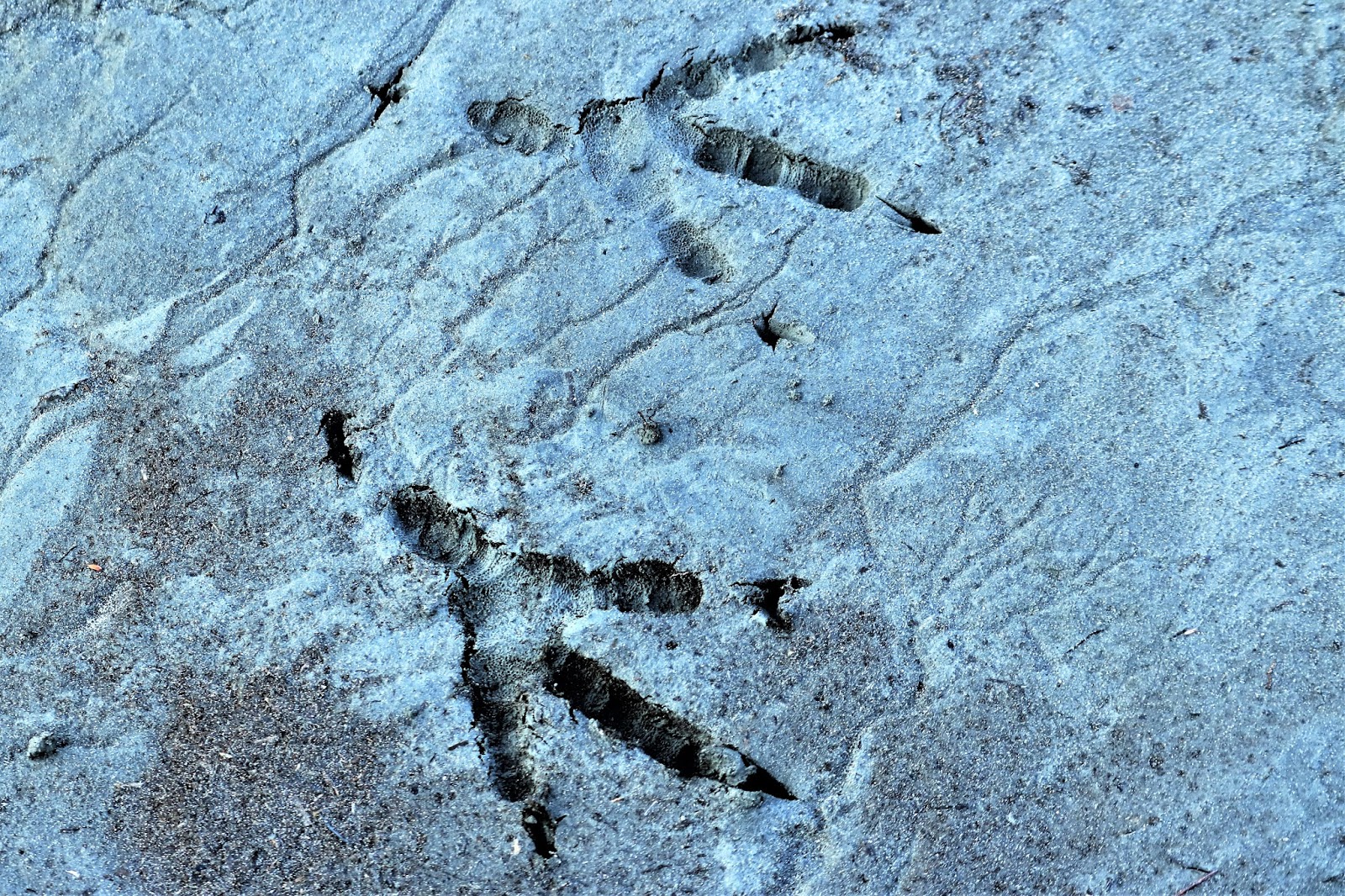
The following are just some random patterns on a sand bar from the Stikine River taken last summer and one decomposing salmon head freshly dug up out of the sand by a foraging Raven who left his tracks behind while practicing proper wilderness etiquette of "Take only pictures, leave only footprints".


Monday, April 23, 2018

Hooligan, ooligan, eulachon, Thaleichthys pacificus and the coming of spring

 Spring, the season when life and color return to the land after the stark, stalking beauty of the long winter.  The quiet, lurking fear of cold and starvation are driven back once again by a strengthening Sun and its promise of warmth and light.
Spring is the easy season to love:  flowers begin to bloom, butterflies begin to flutter by, birds rejoice at every dawn, and the fecundity of the natural world comes streaming back but, the mornings are still crisp and cool, the biting bugs are still absent, and a fire in the wood stove is still a pleasant comfort to come home to after a day outdoors.  The weather may be a bit on the unpredictable side during this season, but overall it is a time of hope, expectations, and renewal.
Spring is still struggling to spring here in SE Alaska this year, it is still on the cold side of the thermometer and the higher elevations still have a fresh coating of new snow in the mornings but the Robins and Varied Thrushes and Song Sparrows  are doing their best to sing spring into being.  So far this spring we have had the usual migrants passing through:  Snow Geese, Sandhill Cranes, some shorebirds like Western Sandpipers, the Rufous Hummingbirds are here, Snipe, Harriers, etc. representing the avian world and for the last few weeks, the annual temporary increase in the Bald Eagle and Steller Sea Lion populations as they come to feast on the subject of this post.
For those of us living here at the mouth of the last river of its kind in North America, the Stikine, spring also brings aquatic migrants in the form of a small but immensely important fish known by many names:  the eulachon or hooligan.  These fish, a type of smelt, are a bit of a mystery to science, much is known about them but there is nearly an equal amount that is not known about them.  Some of the knowns is the fact that they are such an important food source after the winter season that the Stikine River has the second largest congregation of Bald Eagles in North America during this time.  We know when there are hooligan running up the river because there is an obvious absence of Eagles in town.  Bald Eagles, being as common here as crows in other parts of the country, are a normal daily bird to see, not seeing them is what becomes an unusual event and at this time of year, not seeing them around their normal haunts in town means there are hooligan in the river.  When there are hooligan in the river, we Two Legs also begin to spend more time up the river in small skiffs with jetdrive outboards capable of navigating the shallow channels while the mighty Stikine is a little less mighty with most of its future waters still held fast in the mountains as snow and ice.


The history of humans, hooligan, the Stikine River, and the town of Wrangell is very intertwined.  These small fish are one of the many incredibly rich and important natural resources that the Stikine provides and supports which was, and still is, why humans hold this river so dear.  While there is currently no real commercial industry around hooligan, in the past they were a very valuable commodity of trade and commerce as dried food or rendered down into a very rich and nutritious oil or "grease" consumed by people all along the NW Pacific coast.  Hooligan are still a coveted seasonal food for many people although they seem to have a "love 'em or hate 'em" reputation among most people I know.  Being in the "love 'em" camp, I make an effort to catch as many as I can every spring as I enjoy eating them but enjoy giving them away to others in the "love 'em" camp even more.  It is very easy to give out hundreds of pounds of hooligan once word has spread in town that there are hooligan available!


This is my friend Martin successfully fishing for hooligan with a cast net.  Beach seines, dip nets, and cast nets are all effective means of harvesting these fish although cast netting is my preferred method - I like the exercise it provides, the needed skill for the actual throwing of the net, and how clean the fish are when put into the cooler.  The first photo in this post was of an unsuccessful drag along a stretch of beach with a beach seine, it is good to have several different hooligan catching tools at your disposal as sometimes one is more effective than another.  On this day, the cast nets were the most effective.


A pretty decent catch on that throw!  We were consistently getting a couple dozen fish per throw and in about one hour, we harvested at least 300 pounds of hooligan.


That is what all the fuss is about, those slender, delicate little fish.  Thousands of sea gulls and Bald Eagles and hundreds upon hundreds of seals and sea lions congregate in the Stikine just for the nutritious benefit of these creatures.  Hooligan are a type of smelt, they are in the smelt family, but are much different than the other smelts in some ways.  The predominant way is the amount of oil they contain within their bodies.  Samples of hooligan have been found to contain 18-20% oil.  Compared to the oil contents of other similar food fishes, this is double to triple the amount of oil found in fish like capelin, sand lance, and herring!  The oils in hooligan are mostly mono-unsaturated fats, particularly oleic acid.  Oleic acid is an extremely beneficial compound that has been proven to lower blood pressure, increase HDL, the "good" cholesterol, increase brain and nerve function, and a whole host of other good things.  There is also an interesting connection between oliec acid and fire ants which I will let you research on your own if you are interested.  Hooligan are also high in Vitamins A and E as well as calcium, iron, and zinc so it isn't hard to guess why so many creatures come from so far away to feast on these little packages of energy and nutrition.
Another interesting fact about hooligan is that the males and females seem to segregate themselves into separate waves of returning schools.  On my first hooligan fishing trip this year in early April, about 99% of the fish we caught were female.  On the next two trips later in the month, every single fish that I personally processed, which numbered over 1,000 fish, 100% of them were male.  There are distinct morphological differences between the males and females:  the males pectoral fins are noticeably larger for one and they have a pronounced ridge of muscle running the length of their bodies just above the lateral line.  There are some other less distinctive differences but the two I mentioned are the most obvious.


This is a small bowl of hooligan cleaned and gutted with the heads and tails removed waiting to be processed.  My preferred methods of processing and preserving them is by canning them in a way similar to sardines with either mustard or hot sauce, drying them in a food dehydrator, or pickling them.


This is a packed half pint jar of hooligan ready to be canned.  It takes about 5 fish to fill a half pint jar; about 9 fish for a pint jar.


One rack of cleaned hooligan ready to go into the dehydrator.


A batch of hooligan out of the dehydrator.  I then put them in Ziploc bags in the freezer and eat them as is as a snack or rehydrate them as a sort of fish stock for soups or other dishes.  In this form, they present a high energy, nutritious, tasty, and easy snack:  fish chips!


48 half pint jars fresh out of the canner ready for the pantry!  I did this batch half with brown mustard and half with hipster ketchup (sriracha sauce).  Canning is a lot of work and is a time consuming process so, for me, usually is spread out over the course of 2 or 3 days for the cleaning of fish, prepping fish and ingredients, packing jars, and then the actual canning.  As you can see in the left of this photo, there is a french press of coffee cocked and loaded waiting to be consumed because I unloaded the canners in the morning before work after spending several hours the previous evening doing the canning.


The finished product.  I don't know how to describe the amount of pleasure and fulfillment I get from opening my cabinets and seeing jar after jar after jar of food that I gathered, fished, or hunted.  These jars represent so much more than sustenance: there are memories, experiences, effort, knowledge, wisdom, and risk contained within these jars in addition to the food.  The matter in these jars not only sustain my physical self, they also provide some sort of spiritual nutrition as well.  Occasionally I will open my cupboard doors and spend several minutes just looking at the bounty on the shelves.  Some store bought box or bag of "food" with a long list of ingredients, half of which we don't know what they are, can't give this same feeling of contentment and security.


Jars of hooligan about to go in the refrigerator to become pickled hooligan.  This was my first time pickling them and after a week in the refrigerator, I now declare them a new favorite method of eating hooligan!